A Shopify meta description example, and why Google rewrote yours
Key takeaways
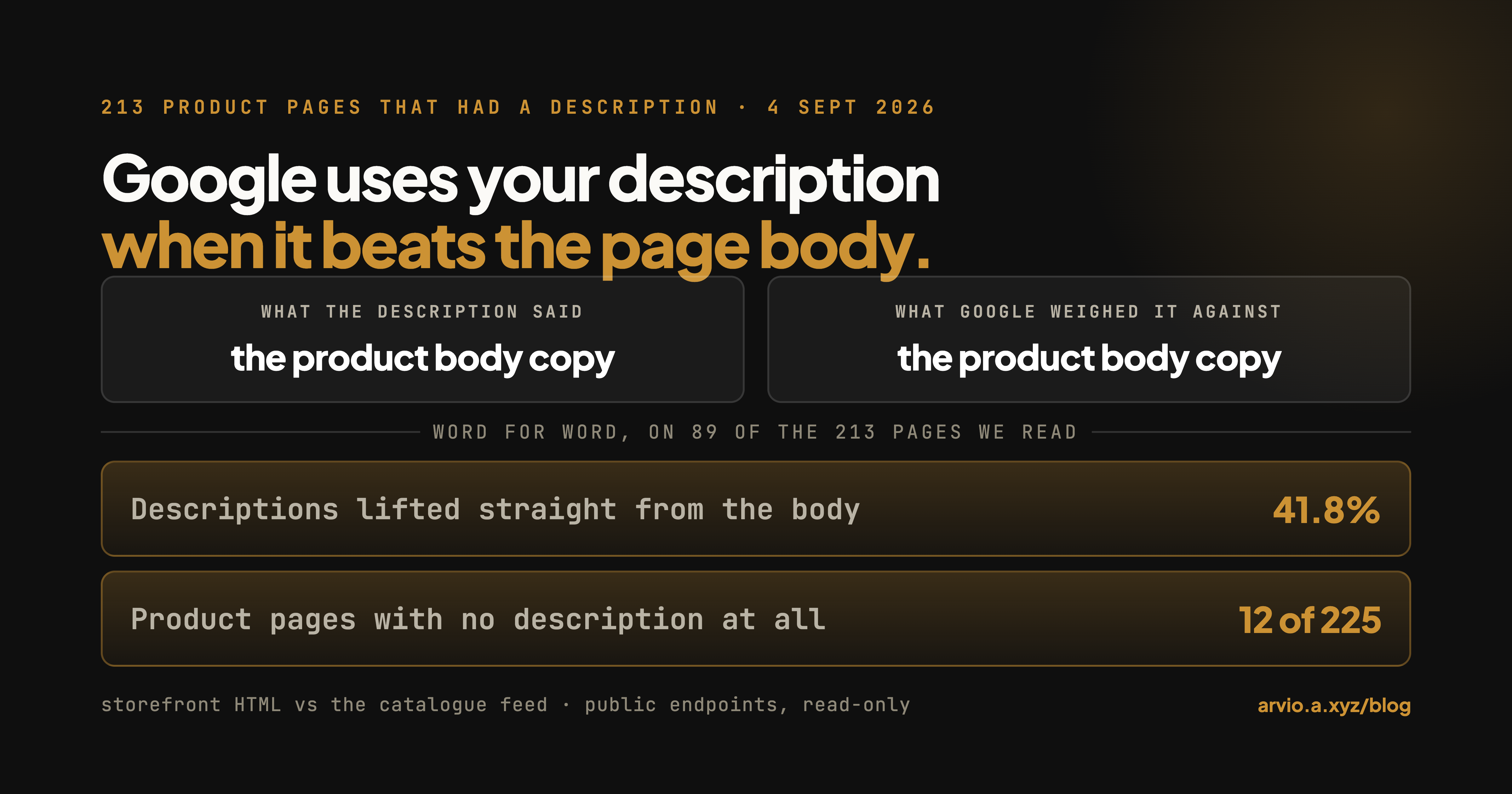
- A missing meta description is the rarer problem. The commoner one is a description that came out of the product description: of 213 live product pages that had one, 89 — 41.8% — opened with a passage that appears word for word in the body copy.
- That is Shopify working as documented. Leave the field blank and, in Shopify's own words, "the product Description is used".
- A description that repeats the page body gives Google nothing to choose. Google's snippet documentation says it uses the field when it "might give users a more accurate description of the page than content taken directly from the page" — and yours is content taken directly from the page.
- Length is not the problem people think it is. Median description in our sample was 163 characters and 51.2% were over the 160 Shopify recommends. Google states there is no limit and truncates to the screen.
- Only 5.3% of the product pages we read had no description at all. If a tool reported hundreds of "missing" ones, check what it counted.
- Before you rewrite anything: check the page actually gets impressions, check whether the description is just the body copy, and check that the first sentence still says what the page is when you delete everything after it.
Published 4 September 2026 by Adot Technologies Inc, the team behind Arvio. The measurements come from reading public storefront HTML on 4 September 2026. The example description is ours and is not click-tested. Method at the end.
One good description is a writing problem; a catalogue of them is not
Arvio reads your live products and drafts a description per page from the real fields — vendor, type, options, the copy you already wrote. Nothing goes live until you approve it.
The quick version
- One example, taken apart below: object and spec first, then the two questions a buyer asks next, then one commercial fact. More of them, for four page types, are in the examples companion piece; the full measurement is in what live stores actually ship in these two fields.
- Why it works: the first clause is a complete answer, the second and third are the two things a buyer checks next, and none of it is repeated from the page body.
- The likeliest reason Google replaced your last one: the field was never filled in, so what is in it came off the page already. This article explains that mechanism; it does not measure how often replacement happens.
- What not to optimise: the character count. There is no number to hit.
The example, clause by clause
15W wireless charging stand for iPhone 12 and later, with Qi2 support for Android. Adjustable 30–70° angle. Ships from the UK.
15W wireless charging stand — the object and its most-compared spec, before anything else. If the snippet is cut anywhere after this point, the reader still knows whether to click.
for iPhone 12 and later, with Qi2 support for Android — the compatibility question. On a product like this it is the one thing a buyer has to settle before anything else matters, so it goes in front of the click rather than behind it.
Adjustable 30–70° angle. — the next attribute someone comparing two stands would look for, written as a short sentence rather than a clause so it survives being read at a glance.
Ships from the UK. — the commercial reassurance, and the only one. Add the returns policy and the warranty as well and the useful part becomes preamble.
What is deliberately absent: the brand name, an adjective like "premium", and any sentence beginning "Our". None of them tells a searcher what the product is, and the opening words are the part of the snippet most likely to survive truncation. For what it's worth, not one of the 213 descriptions we read actually opened with "Our" — the commoner way to waste the opening is a clause about the brand rather than the product.
Why Google rewrote yours
Google does not treat the field as a slot it is obliged to fill from. Its snippet documentation puts the condition plainly:
"Google sometimes uses the meta description HTML element if it might give users a more accurate description of the page than content taken directly from the page."
Read that against what we measured. Of the 213 product pages in our sample that had a meta description, in 89 of them — 41.8% — the description opened with a passage that appears word for word in the product's own body copy. The count is of pages: we read about two products per store, so it tells you how common this kind of page is, not what share of merchants ship one. For those pages the condition in that sentence has nothing to bite on — the field is not more accurate than content taken directly from the page when it opens with content taken directly from the page. Which leaves Google no reason to prefer the field over the page it came from.
And this is not a store owner being careless. It is the platform default. Shopify's CSV reference documents it for both fields:
"If you leave this column blank, then the product Description is used."
So the sequence in these stores is: nobody filled in the field, Shopify filled it with the product description, and the SEO tool reported the page as "has a meta description" — with nothing in it that Google could not already read off the page.
What we did not measure: how often Google actually replaces a description. That would take reading the live SERP snippet for each page and comparing it word by word, and we did not do it. What we can show is the mechanism and how widespread the input condition is.
When the replacement isn't your description's fault
Sometimes the description is good and Google still shows something else. Three cases where that is not a defect:
- The query didn't match it. Google generates snippets per query. A page that ranks for four different searches can show four different snippets, and only one of them can be your description.
- Your description answered a different question than the searcher asked. If someone searches for the return policy and your description talks about materials, the extract from your returns paragraph is genuinely more useful.
- The page body says it better. This is the good outcome. A snippet pulled from a well-written spec table is not a failure.
None of those is worth acting on. The one that is: the description nobody wrote.
The mechanism is easy; the volume is not
One page you can reason about by hand. Four hundred is where it stops being a writing job. Arvio drafts a description per product against your own data, and every draft waits for you.
The three things people optimise that don't matter much
Character count. Shopify's SEO page says:
"Meta description: It's recommended that 160 characters is used in the description."
Google says:
"There's no limit on how long a meta description can be, but the snippet is truncated in Google Search results as needed, typically to fit the device width."
Our sample: median 163 characters, 51.2% over 160, and only 1.4% over the 320 characters Shopify's CSV reference permits (the longest we found was 1,877). Writing every page to 160 would be a lot of work in service of a recommendation that neither platform enforces and that Google explicitly declines to give.
Keyword placement. There is a widely repeated claim that Google has said meta descriptions are not a ranking factor. It is not in the snippet documentation and not in the special tags documentation, so it is not quoted here. What we can say is what the documentation does describe: the field's role there is entirely about the snippet — which makes it a click-through question. Keywords in it are worth including because they get bolded and because they reassure a searcher they've landed in the right place, not because they move a position.
Filling in every page. 5.3% of the product pages we read had no description at all. It is the number audits disagree about most, because a tool that counts Shopify's fallback as a real description and one that counts it as missing will report the same catalogue very differently. Either way, a page that has never been served an impression does not benefit from a hand-written description.
What to check before you rewrite anything
1. Does the page get impressions? Search Console, sorted by impressions. On most catalogues a small number of pages account for nearly all of them. Those are the ones where a rewrite can change anything.
2. Is the description just the body copy? Open the page source, find <meta name="description">, and see whether the text appears in the product description too. If it does, the searcher is being shown text that is already on the page — most often because the field was never filled in, though a merchant who pasted their own body copy leaves exactly the same fingerprint. The admin is the only place to tell those apart. This is the check that flagged 41.8% of the pages that had a description.
3. Does the first sentence survive alone? Cut everything after the first full stop and read what's left. If it no longer says what the page is, the sentence is built the wrong way round — that is the single most common structural problem, and it is independent of length.
Where to edit it
For a product, collection or blog post: open the item, scroll to the Search engine listing block, click the pencil icon, and fill in Meta description. For Online Store → Pages the control is a button labelled Edit website SEO. For the homepage it is Online Store → Preferences — a different place entirely, and the field most often left blank in our sample, missing on 10.3% of the homepages we read.
To do more than a handful at once, the built-in bulk editor has a SEO column group containing Meta description (SEO), or you can round-trip a product CSV using the SEO Description column. In a CSV, remember that a blank cell does not clear the field — it hands the page back to the fallback.
FAQ
What is a good Shopify meta description example?
15W wireless charging stand for iPhone 12 and later, with Qi2 support for Android. Adjustable 30–70° angle. Ships from the UK. — the object and its key spec first, the two follow-up questions next, one commercial reassurance, and nothing repeated from the page body.
Why is Google not using my meta description?
The most common measurable reason is that it opens with text that is already on your page. Google's documentation says it uses the field when it might be more accurate than content taken directly from the page; if your field was left blank, Shopify filled it with the product description, so that condition can't be met. Google also regenerates snippets per query, so a page ranking for several searches will show several different snippets.
How long should a Shopify meta description be?
Shopify recommends 160 characters and permits up to 320 in a CSV import. Google states there is no limit and truncates to fit the device. In our sample the median was 163 characters and half were already over 160, so length is rarely the binding problem — sentence order usually is.
Does Shopify automatically create meta descriptions?
Yes. If the field is blank, Shopify's own reference says the product description is used. That is why so few pages measure as "missing" and so many measure as generated — 41.8% of the ones that had a description opened with text found verbatim in the body.
Is a meta description a ranking factor?
Google's snippet and special tags documentation does not say either way. The role the documentation does give the field is as an input to the search snippet, which makes it a click-through decision rather than a ranking one.
How do I write meta descriptions for hundreds of products?
Don't, in that order. Start with the homepage, the collections, and the products Search Console shows already receiving impressions. For the volume that remains, the bulk editor's Meta description (SEO) column and a CSV round trip on the SEO Description column are the two native routes.
What happens if I clear the meta description field?
You get the fallback, not an empty tag. In a CSV import specifically, leaving the cell blank does not clear the field — Shopify's reference states the product description is used instead.
Method
Sample. 225 product pages and 116 homepages across 117 live Shopify storefronts, 115 of which served product pages, read on 4 September 2026. We drew 120 hosts at random from a public list of 230 stores whose owners had posted their own URL on the Shopify Community's Store Feedback board.
What we requested, so you can repeat it. Per store: /products.json?limit=3, then /, then /products/<handle> for the first two handles that feed returned — whichever two the feed put first, no picking. From each page we read the <head> for <title> and <meta name="description">; "no meta description" means the tag was absent or its content was empty.
Whether it looks like you. Stores that post asking for feedback skew newer and smaller, and the list only keeps hosts still serving a catalogue, so survivorship is the biggest bias. Median product body copy was 616 characters across all 225 pages, or 673 across the 208 that had any.
The funnel. 230 hosts in the public list → 120 drawn at random (seed 20260904, recorded in sample_metadesc_2026-09-04__draw.json) → 117 read (2 served an empty product feed, 1 failed TLS) → 115 stores gave at least one readable product page → we requested 230 product pages and 225 answered (2 rate-limited, 3 failed to decode), of which 213 had a meta description. One of the 117 stores answered its product feed but returned HTTP 500 on its homepage, which is why there are 116 homepages and not 117.
Two findings that do not fit the fallback story, stated rather than smoothed. 17 of the 225 pages had no product body text at all. 10 of those had no meta description, which is consistent with there being nothing to fall back to. But 2 pages had body copy and no meta description — which the documented fallback says should not happen. The likeliest reading is that the theme, not Shopify, decides whether the tag is emitted at all. We did not open those themes to check.
How we scored it. "Description is the body copy" was scored by checking whether the first 60 characters of the meta description appear anywhere in that product's own description text from the catalogue feed. It catches the two common theme patterns and misses any store that reworded slightly, so 41.8% is a floor.
What we did not measure. How often Google actually shows something other than the description. That needs a per-query SERP read and we did not do one. The example description in this article is ours and has no click-through test behind it.
Arvio: AI Store Operator — install it on the Shopify App Store. A description per page, written from your product data, each one held for approval.