Shopify "Default Title" variant: how common it really is

Search for this and the first page is people trying to get rid of it: Shopify Community threads about the validation error, a Reddit post asking how to stop Shopify creating it, and the Liquid docs explaining what the object is. That is all useful when you have the error in front of you, and none of it says how many real products carry the thing.
On 23 September 2026 we read the public product catalogue of 181 Shopify storefronts — 6,473 products, 42,102 variants — and counted.
What Default Title actually is
When a product has no options configured, Shopify still needs something to attach a price and an inventory count to. So it creates one variant and names it Default Title. You did not make that variant. Shopify did. A product cannot exist with none.
That makes it a useful marker: a product whose only variant is called Default Title is one where nobody ever set up options.
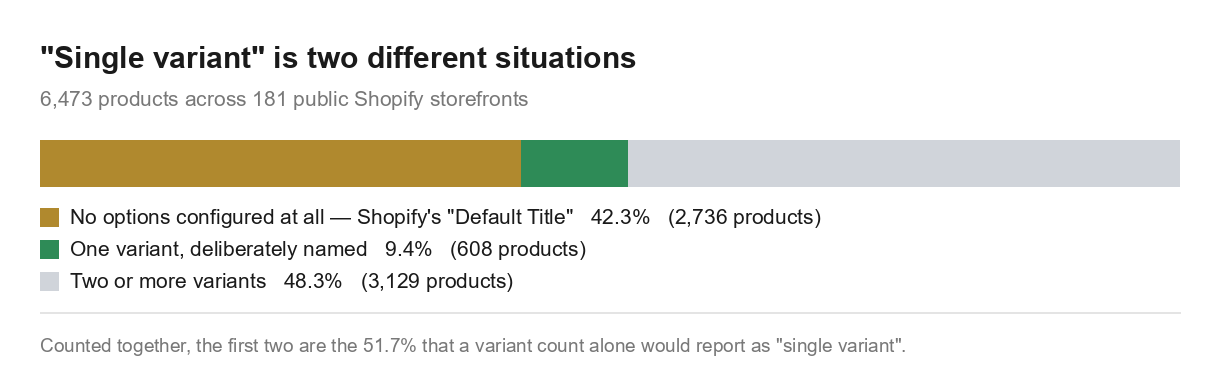
"Single variant" is two different situations
| Products | Share | |
|---|---|---|
No options configured — Default Title |
2,736 | 42.3% |
| One variant, deliberately named | 608 | 9.4% |
| Two or more variants | 3,129 | 48.3% |
Counted the way most audits count, the first two rows merge into a single figure: 51.7% of products have one variant. That number is true and not very useful, because the two halves of it are different situations. One is a product nobody finished setting up. The other is a product where one option was the right answer.
Our own Shopify product page audit reported a single-variant rate and said so in its method: it counted variants and did not inspect variant titles, so a single variant with a custom name counted the same as Shopify's Default Title. This piece is the follow-up that separates them.
Those percentages pool every product together, so stores with big catalogues weigh more. Counting each store once instead: the median storefront has 30.0% of its products on Default Title, and 28 of the 181 stores are on it for every product they list. The pooled figure is higher because the placeholder is more common in the larger catalogues.
See what Arvio does with product data
The other half is extremely lopsided

Among products with more than one variant, the median has 6. The mean is 12.4. One product in the sample carries 168.
That gap between median and mean is the whole shape: 927 products carry more than ten variants and 150 carry more than fifty. Widen the frame to the whole catalogue and the concentration is starker still — of all 6,473 products we read, the 2% with the most variants hold 22.5% of the 42,102 variants. (That 2% is taken across every product, not only the ones with options.)
So a catalogue is usually two catalogues. Most products are simple or empty; a small group of products carries most of the combinations, most of the inventory rows, and most of the work when anything needs changing across the store.
Among products that do have options configured, the names are unsurprising: size on 2,122, color on 1,485, then a long tail — jewelry material, style, and the German farbe and größe from stores selling in their own language.
It makes bulk tools quietly skip things
Bulk tools operate on the axis you give them. A tool that edits variant-level fields silently does nothing to 42.3% of products, because those products have no variant-level anything — just the placeholder. A tool that edits product-level fields touches them fine. If you have ever run a bulk edit and found it "worked on some products", this is a likely reason.
Feeds and channels read variants, not products. Default Title is what a shopping channel sees as the variant name. That is not wrong and breaks nothing by itself.
We expected these products to be the ones missing SKUs as well, and checked. They are not: 70.9% of Default Title products carry a SKU on at least one variant, against 65.9% of products with more than one variant, and 67.8% across the sample. Whatever leaves a product without options, it is not the same thing that leaves it without a SKU.
Nothing is broken about Default Title itself. A candle in one size needs no options. The reason to look at the number is that across the storefronts we read it covers about a third of the catalogue, and some of those products were meant to have sizes. Whether that holds on your store is a thing to check, not to assume — see below for how.
How Arvio works across a whole catalogue
What to check on your own store
Open https://your-store.com/products.json in a browser. That is the endpoint we read — no login, and it is what any crawler sees. It pages: ?limit=250&page=2 gets the next 250, and you keep going until a page comes back empty. Then:
Count how many products have one variant named Default Title. Search the page for "Default Title" and compare the hit count against your product count — that is your version of the 42.3%. If it is far higher than you expected, some of those products are unfinished rather than simple.
Find the handful with the most variants. Those are where a bulk change will cost the most and where an inventory mistake hides longest. In our sample, 2% of products held 22.5% of the variants.
Check whether your single-variant products have SKUs. A product with no options and no SKU is the one that will be hardest to reconcile against a supplier list later. If your catalogue is messy after an import, the cleanup steps are here.
Arvio reads the same fields and writes the fix instead of handing you a report. It flags the products that look unfinished, and you choose the scope: one product, a batch, or the whole catalogue. Every change is approved or rejected before it goes live.
Check your own catalogue with Arvio
How we measured this
The sample frame is the Shopify Community "Store Feedback" board, where merchants post their own store URL and ask strangers for a review. We read the first post of 600 threads, posted between March 2025 and September 2026, and kept every linked hostname that returned a valid Shopify product catalogue — dropping the community's own domain, Shopify's, image hosts, social networks and link shorteners — which gave 185 live storefronts. Each was read once, anonymously, from the public product endpoint, up to 50 products per store. Two never answered — one returned HTTP 402, one HTTP 500 — and of the 183 that did, two carried no products at all. That leaves the 181 storefronts this piece is drawn from — unreachable and empty are different things, and neither is counted as a zero.
What this doesn't show
- This is not a random sample of Shopify. It is a public, reproducible convenience frame. Merchants who post asking for feedback skew newer, smaller, and more likely to be struggling. Anyone can rebuild the same list from the same board, over the same date range, with the same rule.
- We read up to 50 products per store. 107 of the 181 stores hit that ceiling, so for them we saw the first 50 the endpoint returned rather than the whole catalogue. We did not establish what decides that order, and the
updated_atthe endpoint reports came back as the same day for every product we read, so it cannot tell us either. - Excluding those 107 stores moves every headline number, and one of them a lot.
Default Titlegoes from 42.3% to 37.3%. The concentration figure goes from 22.5% to 15.2%, and the largest variant count from 168 to 100 — because the biggest catalogues are exactly the ones we only saw one page of. The direction holds in each case; the size does not. - A variant title is not proof of intent. A merchant can rename the default variant, and we would count that as deliberate. We are reading what the catalogue says, not what anyone meant.
- The public endpoint does not expose barcodes. We can report SKU coverage and nothing beyond it.